|
Dice Influencers!Bet your edge like a professional!CAUTION! This website will challenge your assumptions about the best way to bet!This site's charts are best viewed on a desktop computer or horizontally on phones and tablets.
|
The Truth, Right Up Front!
Why is this information free?This site explains how Dice Influencers (DIs) can harness the power of optimally betting their in-casino edge.
My hope is after reading the information that's free here, including the FAQ, you'll consider ordering my book on Amazon (free on Kindle Unlimited). Better yet, you might decide to get access to the customized simulator I developed that allows DIs to create unlimited scenarios like the examples on this website. The Mad Professor's comment when I introduced these concepts on a DI forum a few years ago was (emphasis his): "You may not realize it yet folks, but YOU ARE SEEING HISTORY BEING WRITTEN HERE!" Have you ever considered turning pro? If you have the temperament and in-casino skillm are willing to trade "action" for consistency with simple, appropriately sized bets, you can tame variance and capture the full potential of your skill. |
Why optimal betting is ideal!Because your skill varies from toss to toss, it can only be confirmed by averaging your performance over many, many tosses. As a result, you never know how much of your last session's win or loss was due to skill and how much was variance.
The good news is if you have a consistent in-casino advantage, eventually you should win. The bad news is you don't know when. In a nutshell, to capture the potential of your skill, the optimal approach is to size your bets for your skill level, your tolerance for risk and the size of your total craps bankroll. The problem? Most DIs vary the size of their bets from small to large in a manner completely unrelated to their edge, thereby wasting the profit and bankroll-building potential their edge could be producing. They're also adding much greater variance to their results. |
Comprehensive Analysis Through Simulation
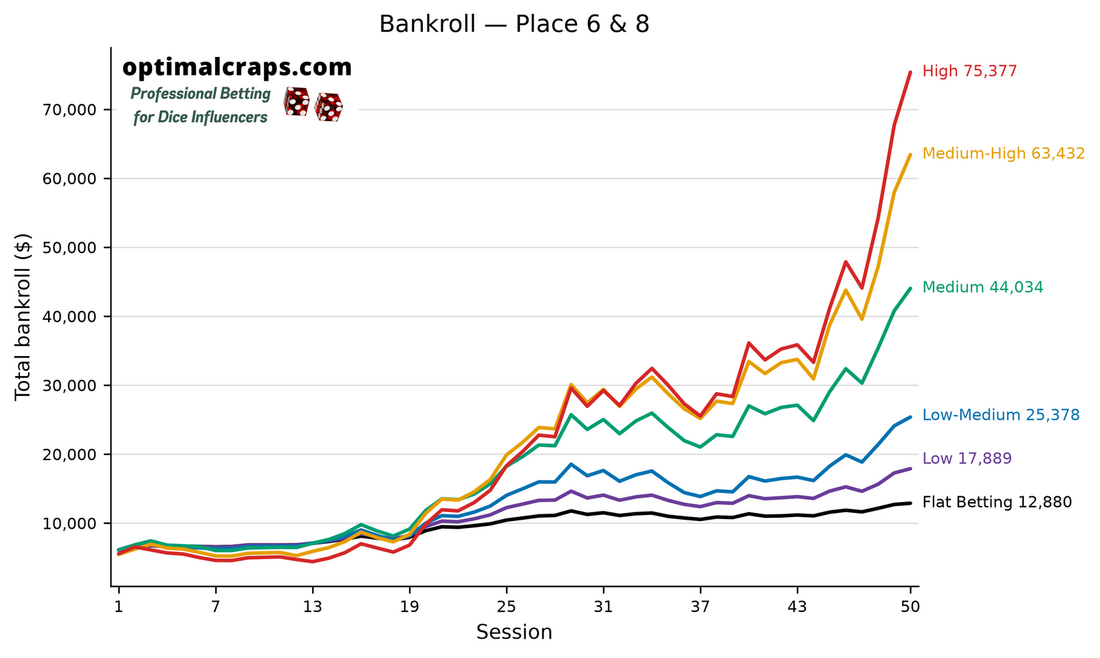
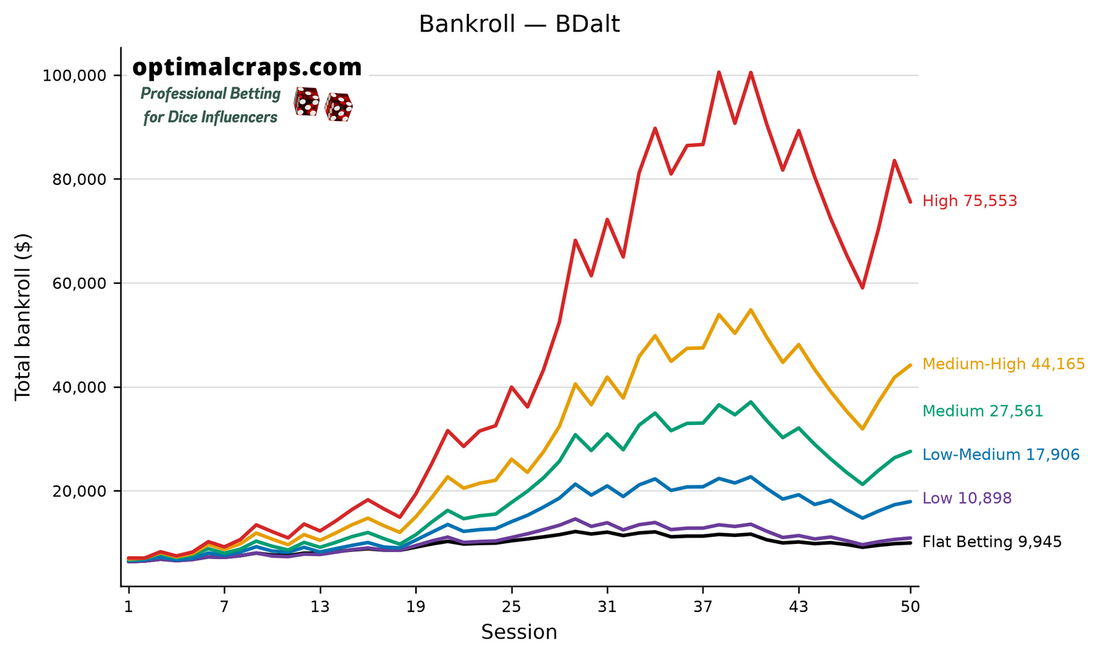
Optimal Craps sizes every bet to your skill and your bankroll, so your edge does the work instead of hot streaks and hunches. Same dice rolls, same skill. The only difference is how much you bet. |
The BDalt method is explained here. |
A custom simulator built for Optimal Craps analysis created the charts and data on this website. Simulator users can enter any Rolls to Sevens Ratio (RSR), a goal for the number of dice rolls in a session, the number of sessions, starting bankroll size, session buy-in size, stop loss as a percentage of buy-in, their betting method, their pass line bet, and a seed for the random number generator (RNG). Control over the RNG seed is important for users to be able to explore different variables with the same dice roll sequence. Of course, the RNG seed can be changed or reused anytime.
Optionally, users can choose a win goal, a trailing profit stop, whether to work place bets or odds on come out rolls, and whether to create a session loss recoup target if the session bankroll drops by a user-defined percentage. They can also select a custom bankroll percentage risk level, such as 1.75%.
For later analysis and comparison, in addition to the dice rolls from each session, the simulator exports charts and tables like those below (and much more) to a downloadable Excel file.
The power of optimal betting
To perform analysis like the examples on this website, the only metric you need is your in-casino Rolls to Sevens Ratio (RSR). The consistently applied rules for all of the example runs on this website were:
- $6,000 starting total craps bankroll (Session buy-ins and starting bankrolls can be higher or lower)
- 6.5 RSR (Rolls to Sevens Ratio)
- 50 Sessions (Sessions averaged about 105 rolls)
- Working on come out rolls for the 6 & 8 (Which generally improved results considerably but can be turned off)
- Odds bets off on come out rolls for BDalt (Which generally improved results but can be turned on)
- $600 initial session buy-in and loss limit (10% of total bankroll but can be adjusted higher or lower)
- $15 minimum pass line bet (Required to shoot and can be adjusted and/or turned off)
- Flat bet the 6 & 8 at the selected risk percentage for each session.
- Made BDalt bets at the selected risk percentage for each session.
This is why Optimal Craps is so powerful!
Even if you choose a low-variance level, eventually you’ll be betting an amount on every roll likely to be higher than the amount you bet today, especially at the beginning of sessions. Also keep in mind these results are for 50 sessions. Imagine what your bankroll and average bet could look like after a few more sessions, or if you have a higher RSR! With the Optimal Craps Simulator, you can do that kind of "what-if?" analysis for your skill level, your tolerance for risk and your bankroll.
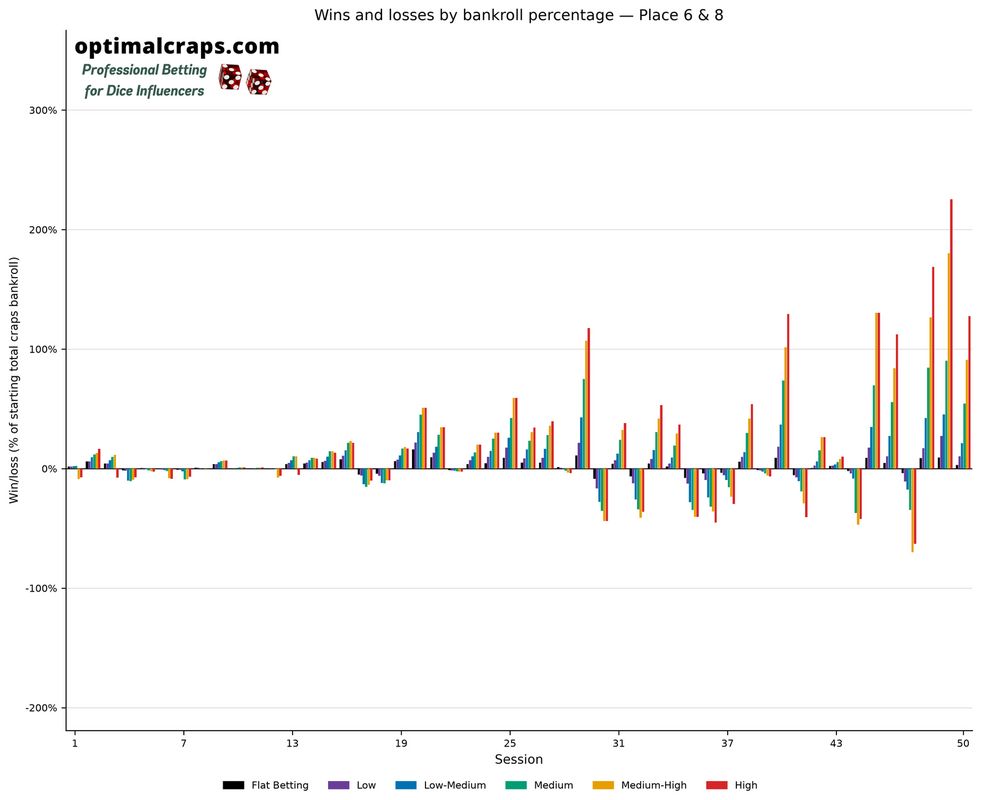
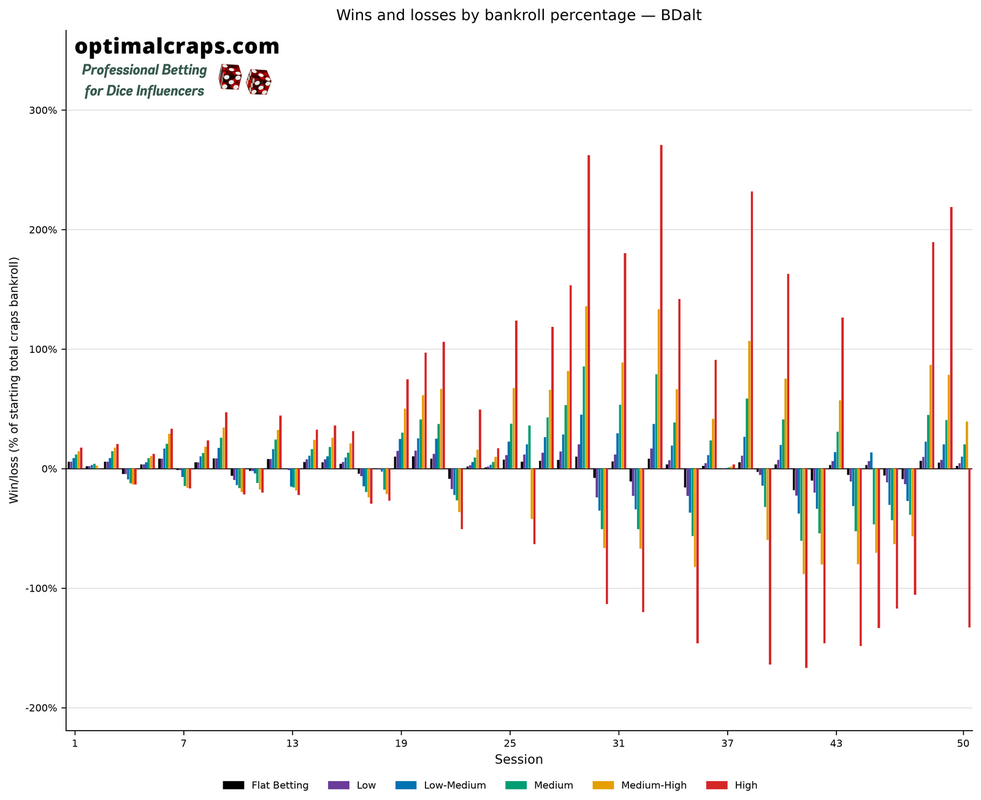
Variance charts for both methods (color-coded)
It's important to note each session only risked its buy-in, which by default is 10% of the total bankroll at the start of that session. The simulator never adds chips during a session, and a session ends when the chips left can't cover the next hand's bets, so a session can never lose more than its buy-in. The win/loss charts, however, compare every session to the bankroll that began the whole run, not the bankroll going into that session. At higher risk levels bankrolls can grow, so bets and buy-ins grow with them. Therefore, a session that loses most or all of its buy-in may show as well over 10% on the volatility chart, but it did NOT lose more than the buy-in of 10% of the total craps bankroll.
Two more looks at volatility
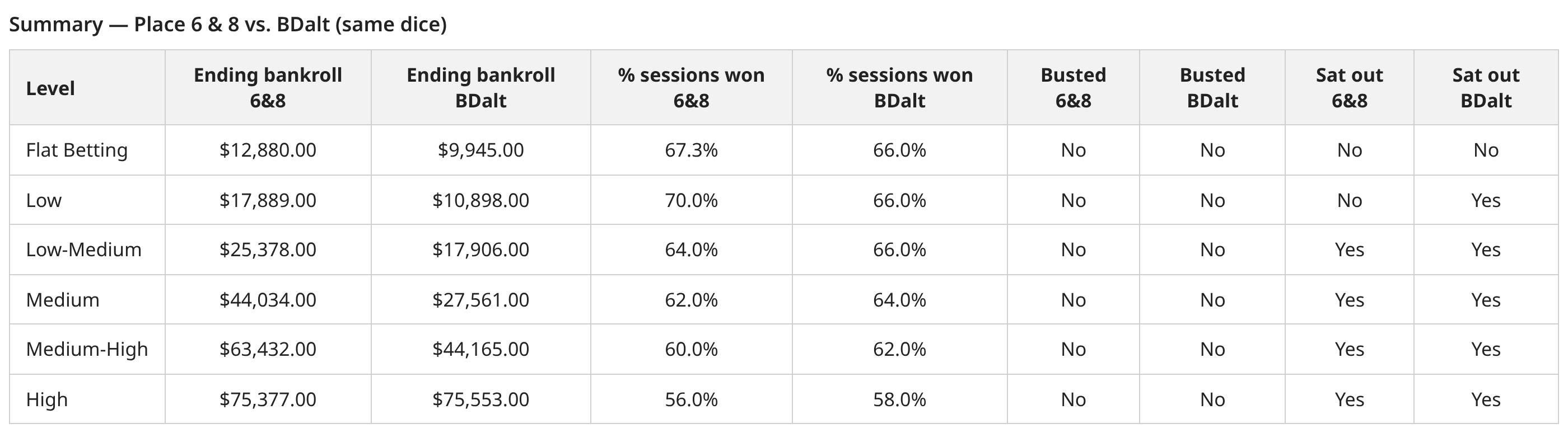
The Optimal Craps Simulator reports the number of sessions won and lost and average session win and loss amounts. Higher levels of volatility generally result in more losing sessions, but the larger amounts for both at higher risk levels may offer higher returns. Interestingly, there are times lower volatility levels outperform higher levels depending on the sequence of rolls.
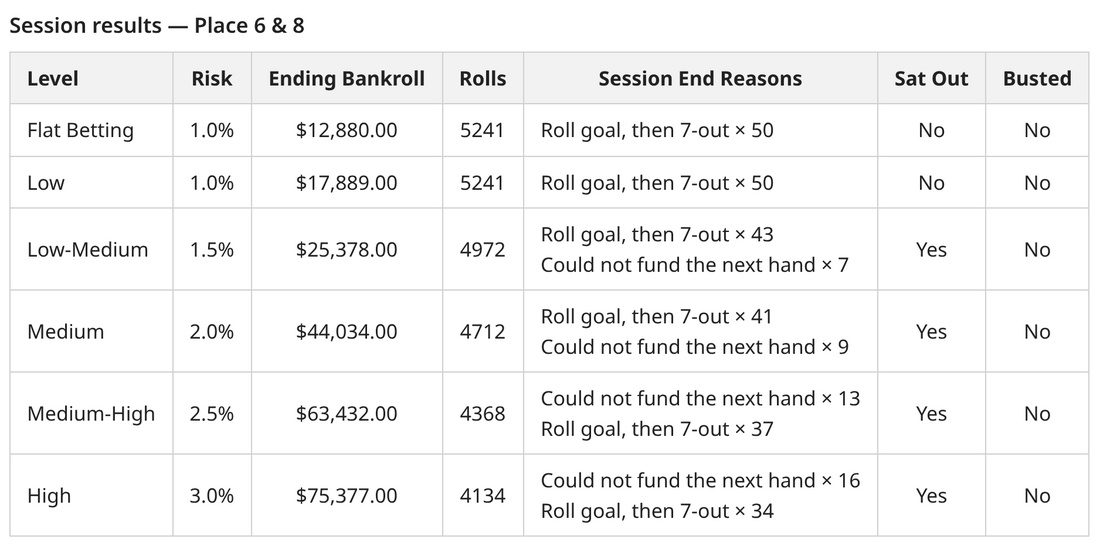
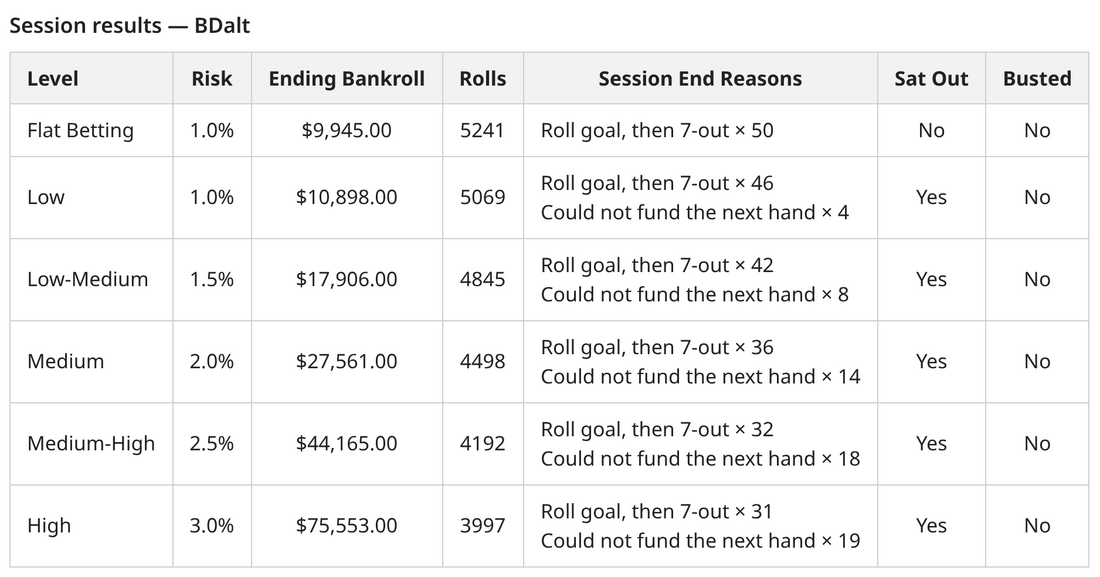
The next table has the number of rolls for each risk level and how many sessions lost their buy-ins. If a session loses its buy-in, the simulator reports it could not fund the next hand, and it sits out the rest of that session's rolls. It also reports how often the roll goal is met (the session ends on the next 7-out). Other parameters are reported if a user opts for a stop loss lower than the session buy-in, win goal with a trailing stop, a recoup loss trigger and if activated, a session loss recovery goal.
Additional Simulator Excel file outputs
In addition to the charts and data from the tables above, for every risk level and for every session the Excel file generated at the end of each simulation run has the ending bankroll amounts, the bet amounts, and the cumulative betting handle. In addition, another tab reports every session's dice rolls in columns and another has all the rolls in a single column should a user wish to copy and paste the dice outcomes into other programs.
DIs typically oscillate between underbetting and overbetting their edge
Do you generally make small bets until a hand starts to get going, and only then begin to bet more? Or, do you bet larger to start and lower (regress) your bets after your initial bets are "paid for"?
With both of these typical DI betting approaches, shorter hands don't win much, if anything, especially if some or all the money won is used to press bets, or if a seven comes before your initial bets are regressed. For medium-length hands, if a seven comes just as your pressed bets have become large enough to generate decent payoffs, you lose what might have been a decent profit when your bets are wiped out. When the occasional long hand does come along, the profits probably won't make up for the losses incurred during shorter hands plus all the wipeouts of pressed bets during medium-length hands.
Think of it another way. If you have a bankroll of $5,000 and make a $5 bet, it’s 1/1,000th of your bankroll. Now, let’s say you're having a long hand and have been pressing your bets to the point where you have $1,000 at risk on the table. Your total bankroll is now up to $6,000. Great, right? Yes, except you’re about to bet 1/6th (16.67%) of your bankroll on the next roll of the dice! It gets worse. You're also adding a tremendous amount of variance to your long-term results!
If you vary your bets similar to these typical approaches, you're only accurately betting your DI advantage for a small number of your tosses, and then, only by accident!
Select your level of risk and change it anytime you want
It's important to note you can choose a level of variance on a continuum from very low to incredibly high. There aren't just five levels as shown in the examples above. The simulator also has an option to set a customized risk level like 1.75% or any other level.
The importance of mitigating the inescapable impact of variance
You've seen why if you have an in-casino edge, what you bet, when you bet and especially how much you bet have a huge impact on your results. Betting optimally lets you decide how much variance you're willing to endure, and allows you to adjust your betting level accordingly, whenever you want.
Variance is dramatically influenced by three major factors:
Variance is dramatically influenced by three major factors:
- Skill – Greater DI skill equals lower variance. The opposite is also true!
- Betting – Choosing what to bet on and how much to bet is the key.
- Bankroll – Of course, a bigger bankroll means bigger bets and larger wins.
Examples of how you can apply optimal betting
If you have a small bankroll, you might decide to accept a higher level of risk with the idea you can replenish your bankroll if necessary. In that case, you'll probably choose a medium-to-high variance level. If you’re successful building your bankroll early on, you may opt to lower your betting level to have lower risk and less variance. Of course, your profits and bankroll growth rate will be impacted, but if you're betting at higher levels, you may be more comfortable with less variance. With Optimal Craps you can change your exposure to variance anytime you wish!
DIs with in-casino RSRs higher than the 6.5 level used in the examples above will benefit from the mitigating effect their greater advantage has on variance. In other words, a DI with more skill can bet the same amounts as a DI with less skill with lower variance. Or, a more skilled DI may choose to bet more (and win more) with the same level of variance a less proficient DI would experience making smaller bets.
In short, the versatility of Optimal Craps allows you to customize your betting approach anytime to maximize the profit potential of your ability and bankroll with the level of risk you choose!
Another benefit of Optimal Craps
When you always know what numbers you’re going to bet on and how much you’re going to bet, you can concentrate on your DI mechanics!
Most craps players are constantly thinking about what they should do next, or after a 7-out, what they should have done. When you're shooting, how much time and mental energy do you expend planning your next bet? Are your thoughts along the lines of:
Instead, imagine playing with a consistent plan.
The bottom line? To be consistently successful as a DI, you have to know your in-casino skill level; decide the amount of bankroll risk you’re willing to accept; and bet accordingly.
Most craps players are constantly thinking about what they should do next, or after a 7-out, what they should have done. When you're shooting, how much time and mental energy do you expend planning your next bet? Are your thoughts along the lines of:
- Should I just collect my win?
- Should I regress my bet(s)? How much?
- Should I come down?
- Should I press? How much?
- Should I parlay?
- Should I place the number that just rolled?
- Should I place the partner of the number that just rolled?
- Should I bet a hard way? Which ones? How much?
- Should I bet the field? It’s been (dead/active). How much?
- There's a horn number! Should I bet it? How much?
- Oh wow! All I need is a 10 to win my all-tall-small bet! Should I lay the 10?
- OMG, I’ve got a LOT of money on the table! Should I regress or go off or let it ride?
- And on and on and on and on and on . . .
Instead, imagine playing with a consistent plan.
- You always know what to bet for every roll.
- You can play at higher limit tables so you’re playing alone, or nearly so, without as many distractions.
- The betting level you use is appropriate for your skill level and bankroll, so you’re not as stressed about the amount of money you have at risk on the table.
- When you 7-out, you get the dice back faster and ready yourself for “just another toss” so you’re able to focus on your stance, your set, your grip, your landing zone and your toss.
The bottom line? To be consistently successful as a DI, you have to know your in-casino skill level; decide the amount of bankroll risk you’re willing to accept; and bet accordingly.